Human-in-the-Loop Is Now Employment Law
For two years "keep a human in the loop" has been governance advice: sensible, widely repeated, and easy to satisfy with an approve button. In California it is about to become a legal duty for one class of decision - disciplining or firing an employee.
SB 947 does not ban AI in HR. It bans letting the machine be the only one who decided. For anyone building agentic workflows that touch a person's job, the approve button is no longer enough. The loop has to produce evidence.
Hire Me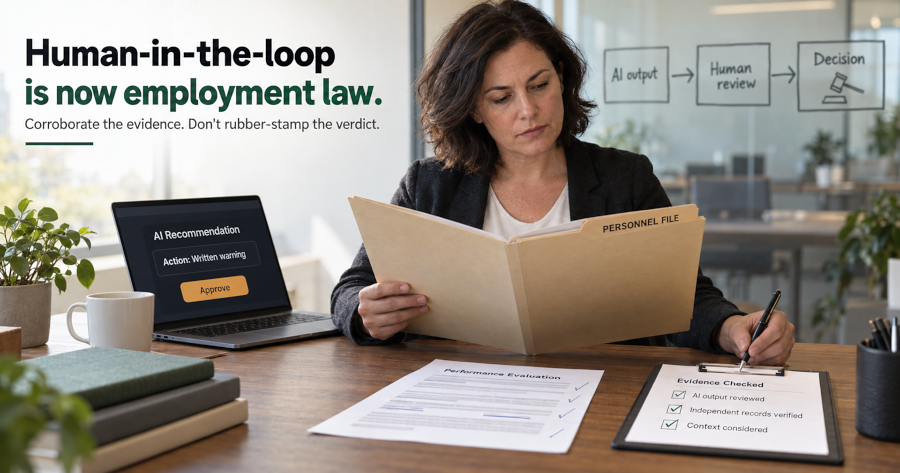
What SB 947 Actually Requires
Governor Newsom signed SB 947, the No Robo Bosses Act, on 30 September 2026. It takes effect on 1 July 2027 and applies to California employers, public and private, regardless of size. It follows a version he vetoed the year before, and it covers employees, not independent contractors. The core of it fits in five lines:
- No sole reliance. An employer may not rely solely on an automated decision system to discipline or terminate an employee.
- Human corroboration. When the employer primarily relies on the system's output, a person has to corroborate the decision against other information - evaluations, personnel files, work product, witness accounts and similar evidence.
- Written notice. The affected employee gets a written notice that an automated decision system was used, with a human they can contact.
- Data access. The employee can request a description of their own data the system used in the decision.
- Prohibited uses. An automated system may not be used to infer an employee's protected status, or to take adverse action against someone for exercising legal rights - however much or little the employer relied on it.
The definition of an automated decision system is broad: a computational process built on machine learning, statistical modeling, data analytics or AI that produces a score, classification or recommendation used to assist or replace human judgment. Spam filters, firewalls, calculators and plain databases are carved out. An LLM agent that reads tickets, timesheets and chat logs and recommends a performance action is squarely inside it.
What the statute does not define is "primarily relies." Employment counsel already expect that phrase to be where early enforcement and litigation happen, and they agree on one thing: rubber-stamping the system's output will not count as corroboration.
Why Agentic Workflows Are Exposed
Most human-in-the-loop designs are approval gates. The agent does the work, assembles a conclusion, and a person clicks approve. That is a reasonable control for merging a pull request, where the reviewer can read the whole diff and the change can be reverted. It is a weak control for a decision about a person, because the reviewer is shown the verdict and asked to agree with it.
Agentic HR tooling makes this worse in three specific ways:
- The evidence arrives pre-digested. An agent that summarizes six months of activity into a recommendation has already decided what mattered. A manager who reviews the summary is corroborating the agent against itself, not against other evidence.
- The decision is spread across steps. A monitoring agent flags, a second drafts the write-up, a workflow schedules the meeting. No single step looks like "the decision," so nobody designs the corroboration point - and the chain as a whole can still be the thing the employer primarily relied on.
- Throughput pressure erodes review. When the system is fast and usually right, review time collapses toward zero. An override rate that drifts to nothing is the operational signature of a rubber stamp.
None of this is unique to HR. It is the same verification problem every agentic workflow has. SB 947 is simply the first place a legislature has written down what an inadequate review looks like, and attached a notice obligation and an enforcement path to it.
Designing a Checkpoint That Counts
If an agent in your stack can contribute to a discipline or termination decision, this is how I would shape the workflow before July 2027. It is engineering, not legal advice - your employment counsel decides what "primarily relies" means for you - but every item is something counsel will ask the system to prove.
- Classify the decision, not the tool. Tag every workflow whose output can feed discipline or termination, including the upstream flagging agents. That tag, not the vendor's marketing, decides which controls apply.
- Show the reviewer evidence, not a verdict. Put the underlying records in front of the reviewer, and keep the agent's recommendation one click away rather than at the top of the screen.
- Make corroboration a structured record. The reviewer cites the independent sources they checked - an evaluation, a personnel record, a conversation - and states whether each supports the output. A free-text "looks good" is not corroboration.
- Build the reject path first. When the output cannot be corroborated, or the reviewer finds it inaccurate or incomplete, the workflow drops it as support for the decision. If rejecting is harder than approving, the gate is decorative.
- Strip protected-status signals at the input. The prohibition on inferring protected status applies regardless of reliance, so it belongs in the data pipeline and the model's feature set, not in a policy document the agent never reads.
- Generate the notice and the data description from the trace. If the audit trail records what the system read and what the human checked, the employee notice and the data-description response are reports over that trail. If it does not, they become an archaeology project after the fact.
- Measure the reviewers, not just the model. Track override rate, time spent per review and how often reviewers cite evidence the agent did not surface. A reviewer who has never disagreed with the system is evidence against you, not for you.
"A human in the loop who only ever sees the verdict is not a control. It is a signature."
The useful side effect is that a workflow built this way is better engineering anywhere. The same structure - independent evidence, a real reject path, a trace that can answer "why" - is what makes an agentic system defensible to an auditor, a board or a customer, whether or not a statute requires it.
What the Sources Say
- Crowell's client alert walks through the definitions, the corroboration duty, the notice contents, the data-access right and enforcement by the Labor Commissioner, and flags "primarily relies" as undefined and the likely battleground. Crowell on SB 947 (signed 2026-09-30; effective 2027-07-01; verified 2026-10)
- HR Dive covers SB 947 alongside the other worker-AI bills signed the same week, including SB 951, which extends California's mass-layoff notice law to layoffs caused by AI, and notes the earlier version was vetoed for overly broad restrictions on AI tools. HR Dive on California's worker-AI bills (verified 2026-10)
- SHRM opposed the bill and says it will weigh in on implementation - a reminder that what counts as meaningful human review is still being argued, and that the safe design is the one that produces evidence either way. SHRM on SB 947 (verified 2026-10)
What I Do About It
I treat human-in-the-loop as a system property that has to be designed, instrumented and audited, not a step someone adds at the end. Where a decision affects a person, the checkpoint gets the same rigor as an access-control boundary: a defined owner, evidence captured as structured data, a reject path that works, and metrics that show whether review is real.
SB 947 makes that design mandatory for one decision in one state. It will not be the last law to do it, and the teams that build the evidence trail now will not have to retrofit it under a deadline.
Hire Me →