AI Adoption Is Behavior Change
AI adoption in engineering is not a tooling rollout. It is a behavior change, a workflow change, and a trust problem. Increasing adoption is not about buying more tools - it is about removing the friction between "I should try this" and "this actually helps me ship better software."
Most engineering teams do not have an adoption problem because engineers are resistant. They have one because leadership rolls AI out like a corporate wellness program.
Hire Me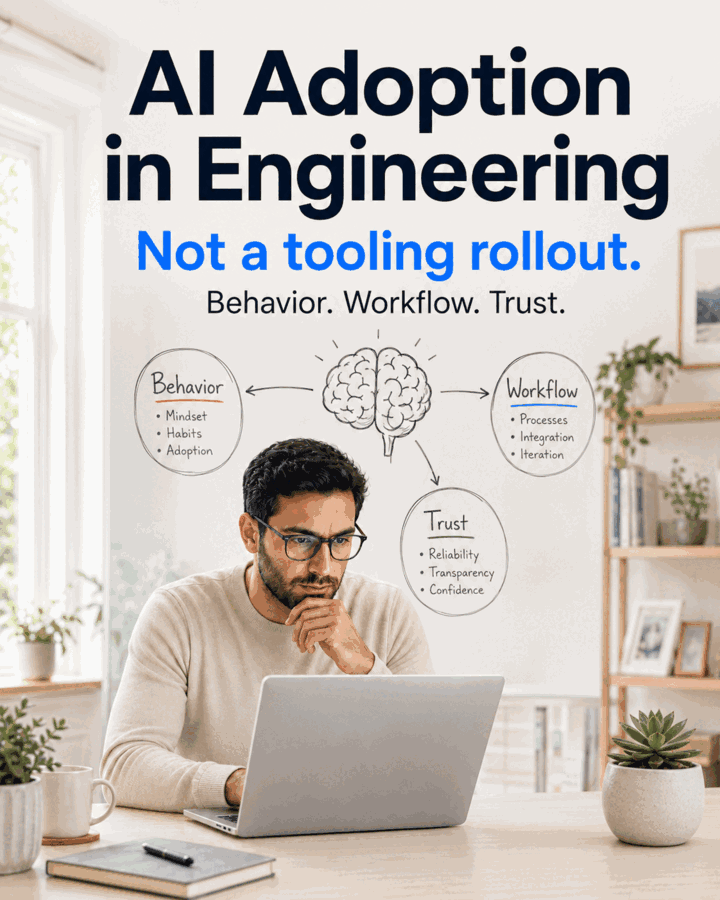
The Question That Moved an Architect
A software architect on my team was, by his own description, risk averse and cautious with change. Exactly what you want in someone guarding a production codebase. He had run a few small experiments, seen a lot of noise and mixed opinions online, and parked it there.
He was not wrong to be cautious. He was wrong about where the risk actually was.
So I did not hand him a mandate, a license, or a forty-slide adoption deck dressed up as strategy. I showed him. I sat down and demonstrated how I was using the tools in my own work - real code, real pull requests, real trade-offs. Not a vendor demo where everything works because the codebase has no history. Then I found the places where his caution had quietly become the bottleneck, and asked one question.
"If the downside is this small, what exactly are we protecting by waiting?"
He jumped in feet first. Within weeks he was proficient, and he later described his own AI journey as having two phases: before that shift, and after it.
The impact compounded. The team moved faster on static-analysis gates in CI. Pipeline automation improved. Quality conversations got sharper. The stability and velocity we had been trying to unlock for years finally started showing up in the system - not because AI replaced engineering judgment, but because it removed friction from work one of our strongest engineers already knew needed doing.
What Actually Works
- Start with real engineering pain. Do not lead with "here is our AI strategy." Lead with where reviews are slow, where tests break trust, where onboarding hurts, where people do repetitive work a machine can do badly at first and well with guardrails. Adoption starts where pain already has budget.
- Make it part of the workflow. If engineers have to leave the IDE, context switch, paste code into five tools and reconcile the output by hand, adoption dies. The best AI tooling feels like infrastructure, not homework. It lives in the pipeline as a stage, not on a slide as a demo.
- Create guardrails, not handcuffs. Clear rules on what data can be used, which tools are approved, what requires review, what cannot be trusted, what must be verified before merge. The goal is not to move fast and hallucinate. It is to move faster with evidence.
- Measure outcomes, not seats. Cycle time, review latency, test coverage, escaped defects, onboarding time, incident triage speed, developer flow. If the metric is "we bought 200 licenses," procurement had a sprint and engineering did not.
- Let engineers lead the patterns. The best adoption comes from internal champions building repeatable examples: prompt libraries, review patterns, test-generation flows, architecture checklists, local conventions, and demos that show real before-and-after results. Engineers trust working software. The same rule applies here.
- Treat skepticism as a feature. A skeptical engineer is not blocking progress. They are protecting production. Bring them in early, let them find the sharp edges, then use what they find to make adoption safer and more useful.
What the Evidence Says
- Access is no longer the constraint. DORA found that "ninety percent of this year's survey respondents report using AI at work, a 14.1% increase over the same metric in last year's report," across nearly 5,000 technology professionals. When adoption is already near-universal, the differentiator is not whether your team has access. It is whether the workflow around it is any good. DORA 2025 (source dated 2025-09; verified 2026-07)
- Which is exactly why rollouts alone do not work. DORA's central finding is that "AI's primary role in software development is that of an amplifier," magnifying existing strengths and existing dysfunctions alike. Dropping tools into a team with weak feedback loops does not create good practice. It accelerates whatever practice is already there. DORA 2025 report (source dated 2025-09; verified 2026-07)
- The skepticism is real, rational, and concentrated in your most senior people. In the Stack Overflow Developer Survey 2025, more developers actively distrusted AI accuracy (46%) than trusted it (33%), with only 3% reporting they "highly trust" the output - and experienced developers were the most cautious of all, at a 2.6% highly-trust rate and a 20% highly-distrust rate. Treat that as signal, not obstruction. Stack Overflow 2025 (source dated 2025-07; verified 2026-07)
What I Do About It
The blocker to adoption is rarely the model. It is the gap between an engineer's perceived risk and the actual risk. Senior engineers protect quality by default, and that instinct is a feature. My job is not to override it. It is to recalibrate it with evidence, then champion the ideas they were already trying to push through.
You do not accelerate adoption by being louder. You do it by being the first one in the water, and by asking the question that makes the cost of waiting visible.
Hire Me →