Clarity, Not Proximity
I have led remote engineering teams since 2012. Not 2020. 2012 - eight years before the world was forced into it, back when "we have a team in Eastern Europe" was something you explained to your board rather than something they assumed.
That is not a credential. It is a long, expensive education in what actually breaks when people are not in a room.
Hire Me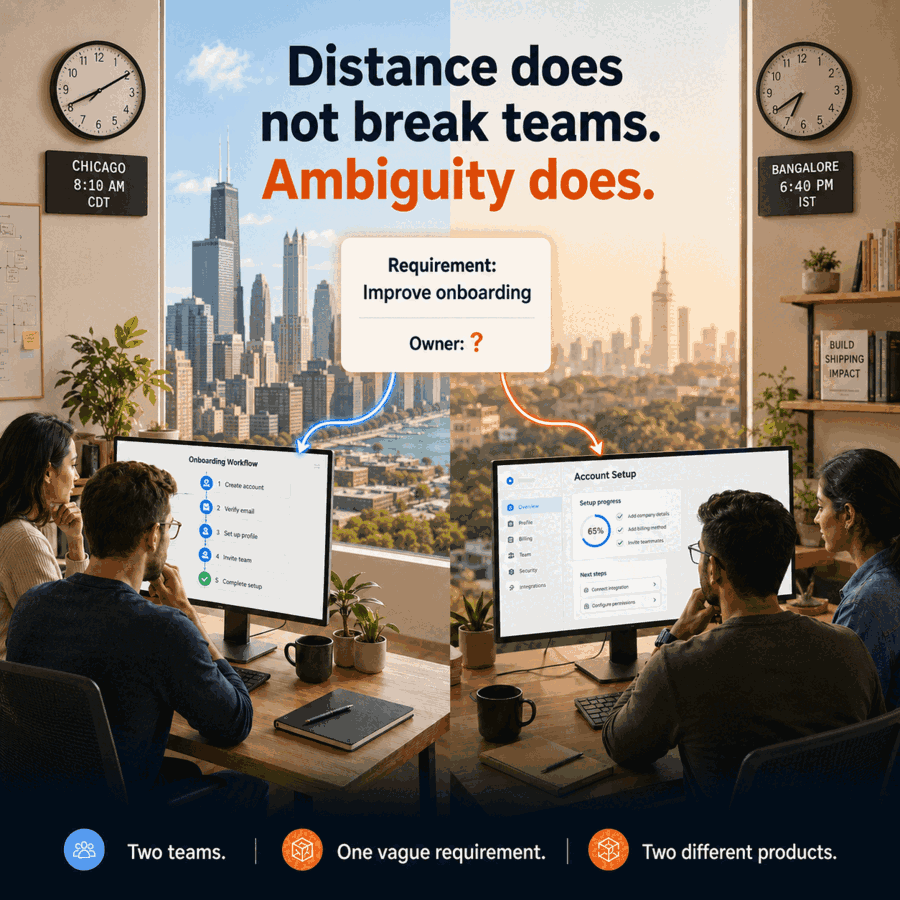
What Actually Breaks at Distance
Distance does not kill teams. Ambiguity does.
Colocated teams survive vague ownership because someone overhears the confusion and fixes it. That rescue is an accident of the floor plan, and distributed teams do not get it. Every unclear decision quietly becomes two people building two different things across a nine-hour time gap, and nobody finds out until integration.
So the fix was never more meetings. It was writing things down and naming the person.
"Autonomy alone is abandonment. Accountability alone is surveillance. The teams that work are the ones where both arrive together."
The second thing: async does not mean slow, it means decisions have to survive being read. If a decision only makes sense when you explain it out loud, it is not a decision yet. It is a preference with a ticket attached.
The third thing took me the longest. You cannot manage a distributed team by watching. You can only manage it by defining what done looks like and then getting out of the way. Every leader who moves to remote and reaches for activity metrics is trying to recreate the view from their old desk. It does not work, and the good engineers leave first.

One Name on the Decision
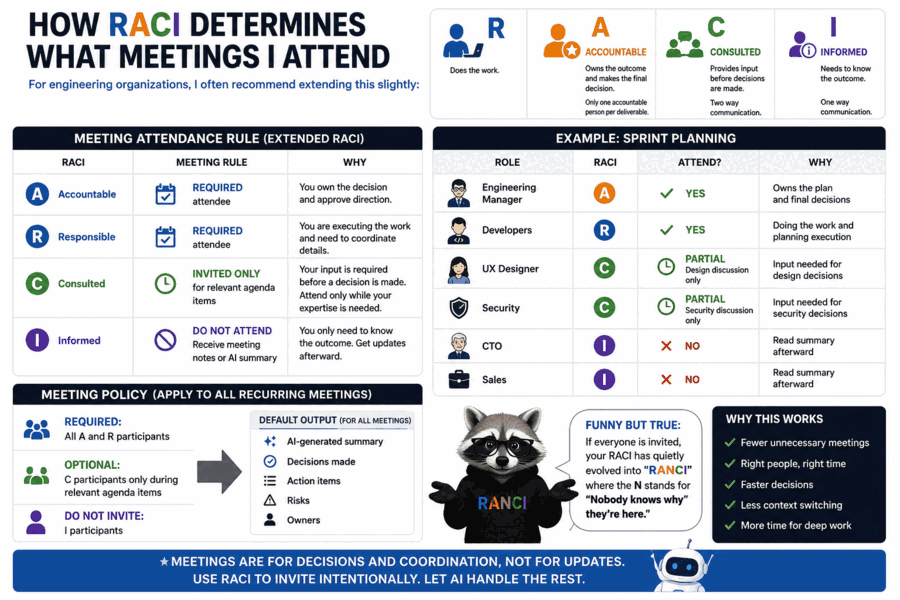
RACI is boring. It is also the difference between a distributed team shipping the right thing and shipping something reasonable that nobody asked for. One name on the decision. Not a committee, not a channel, a name.
The part most teams miss is that a RACI role tells you whether to attend, not just what you own. Run a recurring planning meeting through that lens and it gets obvious fast:
- Accountable - you own the decision and the outcome. Attend.
- Responsible - you are doing the work and planning the technical detail. Attend.
- Consulted - design, security, or data expertise is needed for one agenda item. Join for that item, then drop off.
- Informed - you need the outcome, not the discussion. Read the summary. Do not spend an hour on it.
That last one is where most organizations fail. They confuse "needs to know" with "needs to sit in a meeting." Those are not the same thing. A one-hour meeting with twelve people is not a one-hour meeting - it is twelve hours of company time, and in a distributed team it is twelve hours carved out of four different working days.
If everyone is invited, your RACI has quietly become RANCI, where the N stands for "nobody knows why they are here." Meetings are for decisions and coordination. They are not for status readouts. Let the tooling generate the summary, the decisions, and the owners, and give your engineers their deep-work hours back.
What the Evidence Says
- Tooling amplifies the operating model rather than replacing it. DORA's 2025 finding that "AI's primary role in software development is that of an amplifier" applies directly here: an organization with unclear ownership does not get clearer when it adds faster tools. It gets more of the same confusion, sooner. DORA 2025 (source dated 2025-09; verified 2026-07)
- A deliberate omission: I am not going to quote you a remote-work percentage. The widely circulated 2026 figures on remote share and return-to-office mandates trace back to vendor surveys and content aggregators that contradict each other, and I could not verify them against a primary source. The argument here does not need a statistic - twenty years of running teams across Eastern Europe, the Philippines, India, Ukraine, and China is the evidence, and the pattern has never changed.
What I Do About It
I name an owner for every decision, insist that decisions survive being read without me in the room, and define done rather than watching activity. When a team is spread across nine time zones, written clarity is not documentation overhead. It is the coordination mechanism.
The industry spent 2020 discovering remote work and 2023 declaring it dead. Both takes missed it. Remote was never the variable. Clarity was.
Hire Me →