DeployCos: Why AI Now Ships With Engineers Attached
In May 2026 the two leading model labs said the same thing a week apart. Anthropic announced a new enterprise AI services company with Blackstone, Hellman & Friedman, and Goldman Sachs. OpenAI launched the OpenAI Deployment Company with more than $4 billion of initial investment. Both are built around engineers who go and work inside the customer's business.
The industry now has a name for this: a DeployCo, a deployment company that embeds its own engineers to take models and agents from pilot to production and is accountable for the result.
When the companies selling the models start selling engineers, they are telling you something. The model was never the hard part.
Hire Me
What a DeployCo Actually Is
An API subscription gives you capability and transfers no responsibility for results. A consulting engagement gives you a recommendation and leaves the building. A DeployCo sits between them: its engineers write production code inside your systems, and the engagement is judged on whether something real is running when they are done.
OpenAI calls those engineers Forward Deployed Engineers, or FDEs, a role Palantir made famous over the last decade. Anthropic describes its Applied AI engineers working alongside the new firm's own engineering team. The four jobs are the same everywhere:
Forward Deployed Engineering
Engineers who sit with your teams, learn the actual workflow, and ship code into your environment.
Systems Integration
Connecting models to your data, your APIs, your identity system, and the business systems that already run the company.
Agentic Workflow Engineering
Supervised agents that replace or augment a manual process, with the human checkpoints designed in rather than bolted on.
Managed AI Operations
Evaluation, monitoring, security review, and the continuous improvement that keeps a system good after launch day.
Why the Labs Are Selling Engineers
McKinsey's 2025 State of AI survey found 88% of respondents' organizations regularly using AI in at least one business function, and nearly two-thirds not yet scaling it across the enterprise. Almost everyone has a pilot. Most have not crossed into production.
That gap is not a model problem. It is integration, data access, evaluation, change management, and somebody being accountable when the agent gets it wrong at 2am. Those are engineering and leadership problems, and they are the same problems I write about on this site: verification is the constraint, agents are services, and adoption is behavior change.
A DeployCo is one way to close the gap: rent the engineers who have done it before. Building the capability in-house is the other. Both work. Picking the wrong one for your situation is expensive.
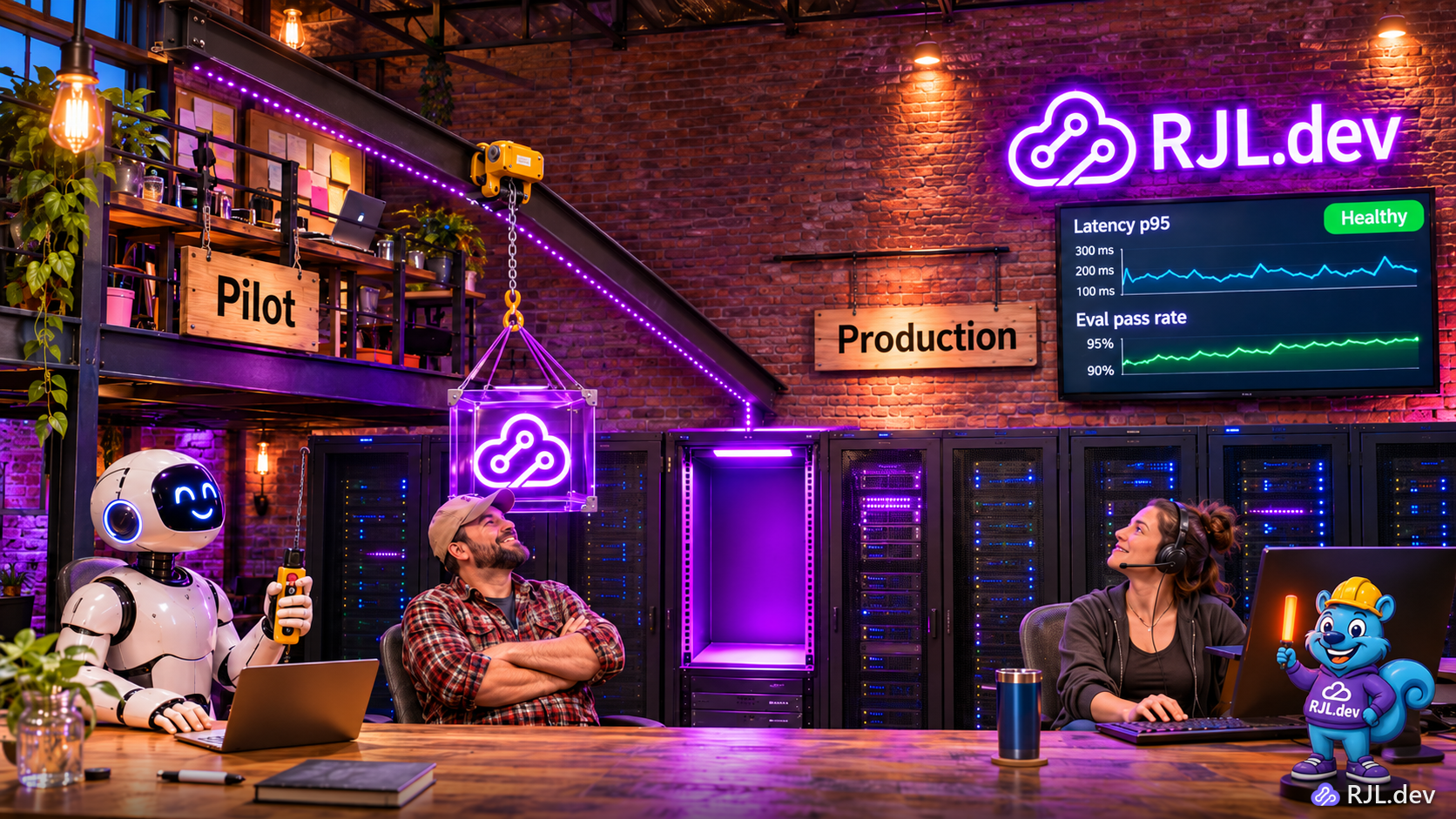
Hire a DeployCo or Build the Capability?
A DeployCo Fits When
- The use case is well defined and close to what the firm has shipped before.
- You need production in a quarter, not a year, and you have no AI engineering bench.
- You are comfortable standardizing on one model vendor's stack for this workload.
Build It Yourself When
- AI is becoming part of how your product works, not a single internal workflow.
- You will run dozens of agents across teams and need one governance model for all of them.
- Vendor neutrality matters, or the knowledge of how the system works must stay in the building.
Most organizations end up with both: a DeployCo for one or two high-value workflows now, and an internal platform team that takes over operations and runs everything after. The failure mode is hiring a DeployCo with no plan for the day it leaves.
What to Demand From Any DeployCo
- A named owner on your side from day one. Embedded engineers are not owners. Someone in your organization answers for the system in production, and they sit in the room while it is built.
- Evaluations you own and can run without them. If only the vendor can tell you whether the system is still good, you have bought a dependency, not a system.
- Code, prompts, and configuration in your repositories. Under your review process and your branch protection, including the rule that a named human owns every merge.
- Governance that matches yours. Data tiers, agent identity, permission scopes, and audit trails that your security team signs off on, not an exception list.
- An exit plan written before the start date. Knowledge transfer, runbooks, and a handover milestone that is part of the contract, not a goodwill gesture at the end.
The Full Reference: DeployCos.com
The category moved fast enough that I built a separate, vendor-neutral reference for it. DeployCos.com covers how deployment companies work, profiles of the major players, the timeline, the risks, and tools for buyers, with every claim sourced and dated. It is not affiliated with any of the companies it covers.
The pages I would start with if you are making this decision:
- Evaluating a DeployCo - the buyer's checklist.
- DeployCo vs. consulting - where the accountability actually sits.
- Forward deployed engineers - what the role is and how to hire for it.
What the Evidence Says
- OpenAI's Deployment Company will "embed engineers specialized in frontier AI deployment, known as Forward Deployed Engineers, or FDEs, into organizations," and "will launch with more than $4 billion of initial investment," through a partnership with 19 investment firms, consultancies, and system integrators led by TPG. OpenAI also agreed to acquire the applied AI firm Tomoro. OpenAI announcement, via Advent International (source dated 2026-05; verified 2026-11)
- Anthropic, Blackstone, Hellman & Friedman, and Goldman Sachs are founding a firm that "will work with mid-sized companies across sectors to bring Claude into their most important operations," with "Applied AI engineers from Anthropic" working alongside its engineering team. Anthropic announcement (source dated 2026-05; verified 2026-11)
- 88% of respondents report their organizations regularly use AI in at least one business function, up from 78%, while nearly two-thirds say their organizations have not yet begun scaling AI across the enterprise. McKinsey, The state of AI in 2025 (source dated 2025-11; verified 2026-11)
Where I Fit
The DeployCo model is how I have always preferred to work: embedded, writing and reviewing real code in the client's systems, and measured on what is running in production rather than on the deck. A fractional CTO or agentic AI engagement with me is the same shape, without a model vendor's stack attached to it.
Sometimes that means building the internal capability so you never need a DeployCo. Sometimes it means helping you pick one, write the contract so the five demands above are in it, and run the handover so the knowledge stays when they leave. Either way, someone on your side should understand the system well enough to say no to it.
If you are weighing that decision now, that is a good first conversation.
Hire Me →